


Why SMEs Need HR Clarity Before Scaling Operations

Last year, I walked into a factory employing 65 workers. The owner had received a labour department inspection notice and needed statutory registers ready within a week.
"We have the records," he assured me. "Just need to organise them."
Three days later, we were piecing together attendance from three notebooks, two Excel sheets, and a WhatsApp group. Payroll registers existed but didn't match bank transfers. Employee State Insurance (ESI) contributions were delayed by months because no one knew which employees qualified.
This wasn't negligence. It was what happens when a business grows from 20 to 60 people without realising that informal systems don't scale invisibly.
The inspection went fine - we reconstructed enough. But the owner said something I hear often: "I thought HR was just paperwork we'd handle later. I didn't know it was the foundation we were building on."
Growth doesn't create HR problems—it exposes them.
That informal salary negotiation with employee 12? Invisible until employee 47 finds out and questions the gap. The unwritten leave policy? Fine until three managers interpret "casual leave" three different ways. The attendance registers you'll "update later"? No issue until a termination dispute lands in court and you can't prove absence.
HR isn't something you add when you get bigger. It's the foundation. Without it before you scale, every additional person becomes weight on a structure never built to hold it.
Six Patterns I See When SMEs Scale Without HR Clarity
Compliance landmines go from hidden to explosive
At 20 employees, missed PF filings might go unnoticed. At 60, they don't. I have seen factories where delayed ESI registrations led to penalties wiping out a quarter's profit. Employment contracts that didn't match actual hours created legal exposure the moment disputes arose.
Compliance risk accumulates silently. Every month without proper registers, every hire without documentation adds to a stack visible only when inspected - by labour authorities, disputing workers, or investors doing diligence.
Pay fairness collapses under its own weight
At 25 people, founders remember who got what raise. At 75, that memory becomes a minefield. One unit I worked with had ten salary structures for the same role - each negotiated separately based on hiring urgency. When employees compared notes, trust shattered.
Without clear pay bands or increment guidelines, every discussion becomes personal. As you add managers and locations, inconsistency becomes inequity. And inequity drives attrition faster than low pay.
Hiring becomes a bottleneck, not a growth lever
"We need someone urgently" is one of the most expensive sentences in an SME.
Without job descriptions, interview structures, or onboarding processes, hiring becomes reactive scrambling. You compromise on fit, skip reference checks, throw new hires in and hope they survive.
Result? High early attrition, extended ramp-up, and perpetual hiring to replace misfits—which keeps you urgent, which keeps you compromising.
I have seen units hire five people for three roles because unstructured hiring prevented accurate capability assessment. The cost isn't just wasted salary - it's management time, lost productivity, and team credibility hits.
Culture fractures across managers and locations
When policies are unwritten and enforcement is manager-dependent, culture becomes a lottery. One manager allows flexible leave; another enforces strict attendance. One supervisor gives warnings; another jumps to termination. Employees notice. They see unfairness, not different styles.
I have worked with SMEs where workers believed their shifts were under-resourced compared to other locations—not because it was true, but because communication and grievance handling were inconsistent.
Scaling without clear structures doesn't preserve culture - it fragments it. Each manager develops unwritten rules. By the time leadership notices the splinter, rebuilding coherence is exponentially harder than creating clarity upfront.
Decisions are made blind
"What's your attrition rate?""Um... maybe 20%?"
"Hiring plans this quarter?""We'll know once people leave."
"Cost per hire?""Never tracked that."
These responses reveal something critical: without structured HR data, SMEs scale blind.
You can't plan capacity without attrition trends. You can't budget headcount without tracking hiring costs. You can't improve retention without knowing why people leave. Beyond internal planning, this blindness closes external doors. Investors want stable teams. Large clients need assurance your operations can handle volume. If you can't produce clean data, you signal risk—even with excellent products.
Every new hire feels like starting from scratch
I once worked with a company onboarding their 50th employee exactly like their 5th—founder chat, loose instructions, hope they figure it out. That's not scale. That's repetition.
Without documented processes, onboarding checklists, or payroll workflows, every new employee requires the same manual effort. You can't delegate because there's no structure. You can't add locations smoothly because each site rebuilds informal systems from scratch.
Early investment in basic structure—documented policies, templated contracts, simple HRMS, clear workflows—means adding employee 60 takes a fraction of the effort of adding employee 10.
What Good-Enough Clarity Looks Like
You don't need a full HR department. You need four pillars:
Documentation that protects: Contracts reflecting reality. Policies written, communicated, and accessible.
Compliance that prevents crisis: Statutory registers maintained monthly. PF, ESI, labor law obligations tracked as routine.
Processes that don't depend on memory: Payroll, attendance, leave managed through systems or structured outsourcing—not spreadsheets.
Basic workforce visibility: Headcount, attrition, costs tracked well enough to answer strategic questions without guessing.
This isn't perfection. It's hygiene. And hygiene allows you to scale without breaking.
Clarity Is the Unlock
One client - a 40-employee manufacturing unit - came to me after payroll errors created distrust. We set up outsourced payroll, digitized attendance, created a simple policy document, and established monthly HR reporting.
Six months later, the owner told me the biggest change wasn't payroll accuracy - it was that he stopped spending half his week firefighting HR disputes. Employees knew where to find policies. Managers had consistency frameworks. Compliance happened on time.
They didn't transform into a corporate machine. They moved from chaos to predictability. And predictability gave them bandwidth to focus on growth.
Scaling without HR clarity is like adding floors without checking if the foundation can hold. For a while, it works. Then one day it doesn't - and repairs cost far more than prevention.
HR clarity isn't about becoming "corporate." It's about building infrastructure that lets you grow without constant firefighting. It's ensuring your 60th hire doesn't require Herculean effort like your 6th.
If you're planning to double your team in two years, ask yourself: could your HR systems handle that tomorrow?
If the answer isn't a confident yes, you don't have a hiring problem. You have a clarity problem. And the time to fix it is before you scale, not after.
Key Takeaways
Growth exposes weak HR foundations: Informal practices work at 20 employees but break at 60 when complexity multiplies.
Compliance risk compounds silently: Delayed PF/ESI, missing registers, and weak documentation become expensive during inspections, disputes, or diligence.
Pay fairness collapses without structure: Negotiated salaries and inconsistent increments create inequity, mistrust, and high attrition.
Reactive hiring becomes a bottleneck: Lack of job descriptions, interview structure, and onboarding increases mis-hires and early exits.
Culture fractures when policies are unwritten: Manager-dependent enforcement creates confusion and perceived unfairness across teams and locations.
Good-enough HR clarity is achievable: Four pillars - documentation, compliance hygiene, repeatable processes, and workforce visibility - create predictability without “corporate” complexity.
Curator’s Note:
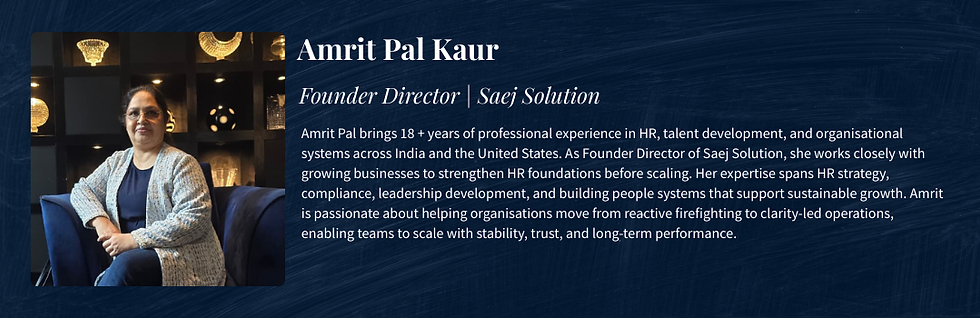
Scaling is often celebrated as growth, but without strong foundations it quietly becomes risk. In this sharp, experience-backed piece, Amrit shows how HR clarity is not “paperwork" - it is infrastructure that protects trust, compliance, and culture as teams expand. A practical reminder that sustainable growth is built through systems, not firefighting.
About Author:


Comments